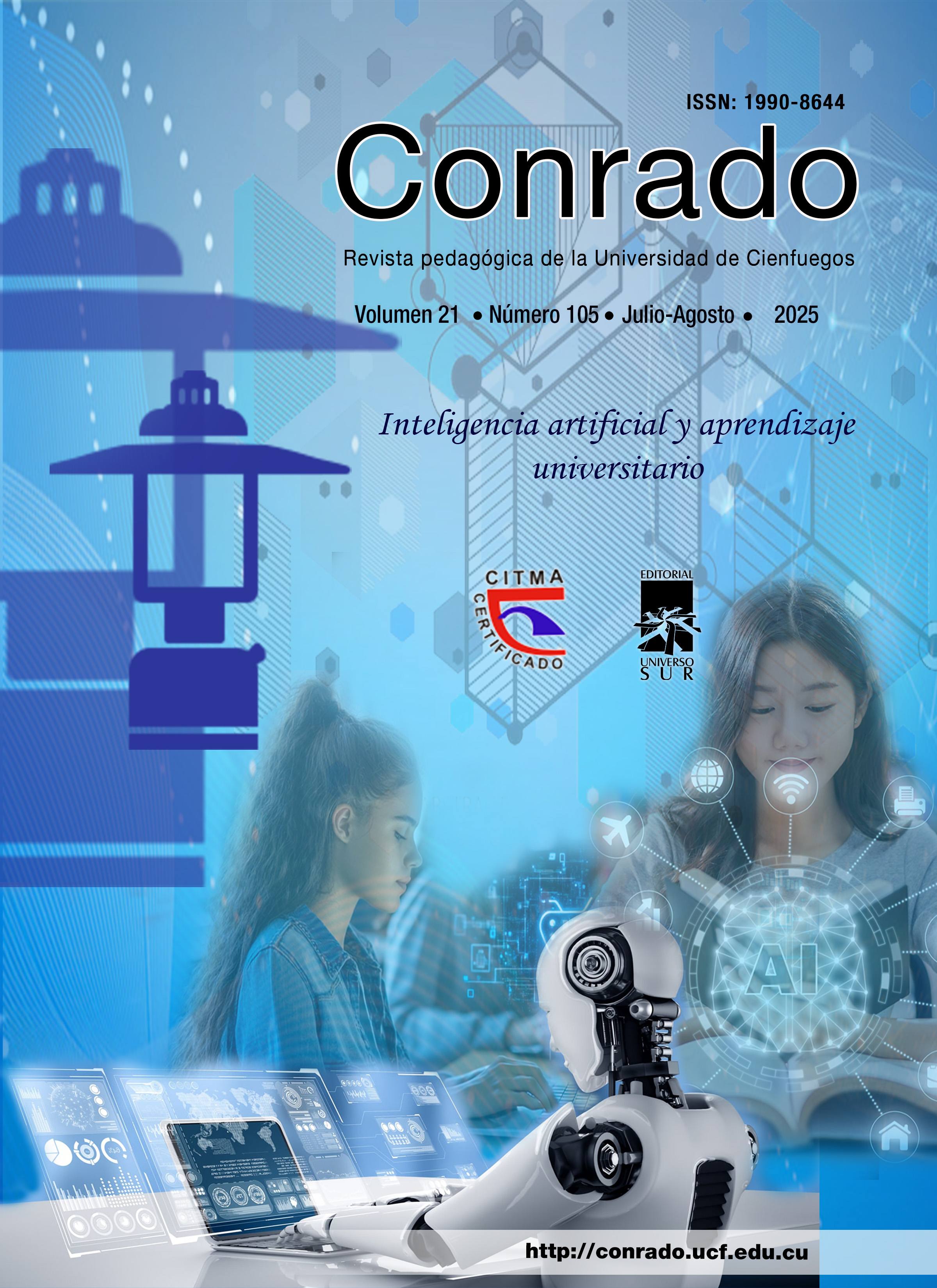
Internet Connectivity, Relationship with the Teaching-Learning Process of the English Language in University Students
Keywords:
connectivity, teaching-learning, English as a Foreign Language (EFL), online educationAbstract
This study addresses the importance of internet connectivity in the English teaching-learning process for university students, highlighting how the digital divide affects academic performance and educational equity. The objective is to analyze the influence of internet connectivity on the English teaching-learning process for first-semester university students of the online Pedagogy of National and Foreign Languages program. Improvement actions are proposed, taking into account the constructivist learning theory, the sociocultural approach, formative assessment, and autonomous learning. The methodology adopted is quantitative and descriptive in scope. Questionnaires were administered to a sample of 33 students, selected through non-probability convenience sampling, to identify perceptions about the influence of internet connectivity on English learning. The main results indicate that most students face frequent difficulties due to internet access problems, which affect their active participation in class and their academic performance. The availability of asynchronous resources, such as downloadable materials and recorded classes, was highlighted as an effective solution to mitigate these problems and ensure learning continuity.
Downloads
Downloads
Published
How to Cite
Issue
Section
License
Copyright (c) 2025 Editorial Universo Sur

This work is licensed under a Creative Commons Attribution-NonCommercial-NoDerivatives 4.0 International License.
"Universo Sur", the publishing house of the University of Cienfuegos, publishes the Conrado Journal under the Creative Commons Attribution-NonCommercial-NoDerivatives 4.0 International License (CC BY-NC-ND 4.0).
You may share the material for non-commercial purposes, provided that you:
-
Give appropriate credit (authors, journal, article link, and link to this license).
-
Do not create derivative works.
-
Indicate if changes were made.
Authors retain copyright.
Full license text: https://creativecommons.org/licenses/by-nc-nd/4.0/